
The Small Camera Revolution: How Portability Redefined Visual Storytelling in 2025
Chase Jarvis told us “The best camera is the one you have with you.” That was 2009. He was talking about carrying a point-and-shoot instead of your DSLR.
Sixteen years later, I’d rewrite it entirely: The best camera is the one you deliberately chose because the moment required it.
That’s not a semantic tweak. It’s a completely different philosophy. One is about convenience. The other is about strategy.
The Shift Nobody’s Talking About
CIPA data for 2024 showed the first increase in camera shipments since 2017. Photography media celebrated. But here’s what they left out: dedicated cameras moved roughly 8 million units. Apple alone ships over 200 million iPhones annually.
Flickr’s upload data tells it cleaner. Apple commands 54% of all uploads. Canon sits at 23%, Nikon at 18%. The iPhone 11—a four-year-old model—logged over 13 million image tags. More than any dedicated camera ever made.
Dedicated cameras didn’t die. They became specialist tools. And that’s not a loss—it’s a promotion.

Stop Asking “What’s the Best Camera?” Start Asking “What Does This Moment Need?”
I was standing at a shoot last month and reached for my iPhone instead of the mirrorless in my bag. Not as a compromise. As the right call. The light was good, the output was social, and speed mattered more than dynamic range.
That decision—tool selection based on the job, not habit—is what separates working professionals from gear collectors.
Here’s how the landscape actually breaks down:
Your Phone: The Always-There Workhorse
The iPhone 17 Pro and Pixel 10 Pro aren’t “good enough” cameras anymore. They’re genuinely capable ones. Triple 48MP sensors, 8x optical-quality zoom, computational photography that captures and combines multiple frames before you finish pressing the shutter.
For social media, web publication, prints up to 11×14″, and anything where speed-to-publish matters? Your phone wins. Capture, edit, publish—one device, five minutes. A technically superior mirrorless shot requiring card transfer, import, color grade, and export arrives after your audience moved on.
Where phones hit walls: True telephoto past 200mm. Real shallow depth of field. RAW flexibility under heavy editing. Sustained video without thermal throttling. And here’s the one nobody mentions—heavy photo use kills the battery on your communication device. Dedicated cameras separate those functions.
Action Cameras: Shoot Without Flinching
The GoPro HERO13 Black ($399) and DJI Osmo Action 5 Pro ($349) serve one purpose brilliantly: go where your real camera can’t.
Helmet mounts. Chest rigs. Rain. Surf. Anywhere damage is likely and your primary gear is too valuable to risk. GoPro now offers modular swappable lenses—ultra-wide, macro, anamorphic. DJI counters with a larger 1/1.3″ sensor, 4-hour battery life (versus GoPro’s 90 minutes), and 20-meter water resistance.
Be honest about limitations: Small sensors choke in mixed lighting. Audio needs external mics. And some clients will question your professionalism if you show up with only a GoPro. Adventure brands love them. Corporate clients? Less so.
Gimbal Cameras: The Content Creator’s Secret
The DJI Pocket 3 ($499) packs a 1-inch sensor, built-in 3-axis stabilization, 4K/120fps, and automatic subject tracking into something smaller than a water bottle.
Walking interviews. Travel content. Real estate tours. Anything requiring smooth handheld video without hauling a gimbal rig. For creators building audiences, consistency and output volume compound faster than occasional perfection.
Same client perception caveat applies. But if your audience lives on YouTube and Instagram, they don’t care what you shot it on. They care if it’s good.
Mirrorless: The Specialist’s Tool
The Canon R5 II ($4,299), Sony A7R V ($3,898), and Nikon Z8 ($3,996) remain the quality ceiling. True telephoto reach. Shallow depth of field with f/1.2 glass. Dynamic range that handles stage lighting and mixed indoor/outdoor. Tethered shooting. Weather sealing that actually works.
You need this when you’re billing enough to justify $8,000–15,000 in body and glass. Weddings requiring redundancy. Wildlife where distance matters. Commercial work with specific deliverable requirements. Editorial print.
For everyone else? It’s credential theater. Expensive gear doesn’t make better photographs. Better decisions do.
The Strategic Kit
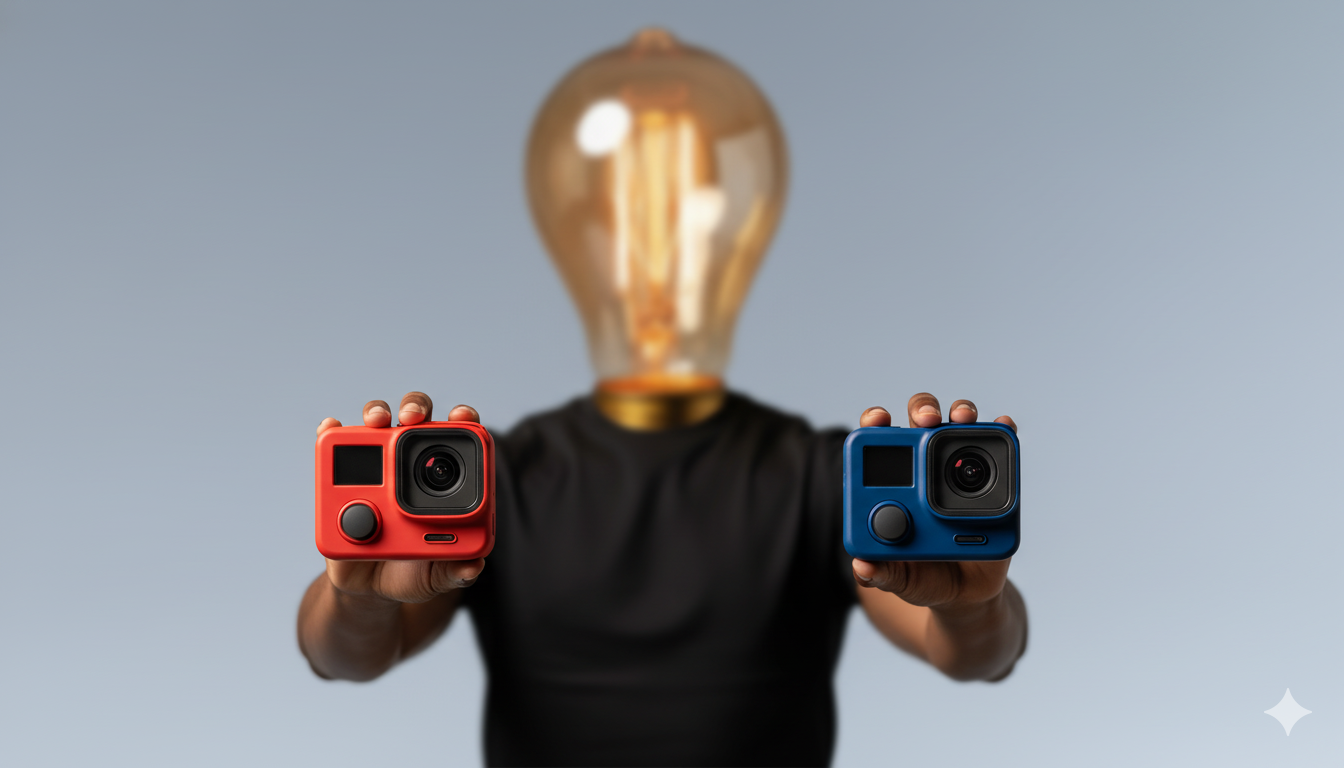
Modern professionals don’t pick one tool. They deploy a system:
- Mirrorless for primary deliverables where the quality ceiling matters
- Phone for behind-the-scenes, social content, and speed
- Action cam for POV and high-risk shots
- Gimbal camera for smooth walking video and b-roll
Here’s the math that should make you uncomfortable: a capable small camera kit—iPhone 17 Pro, DJI Action 5 Pro, DJI Pocket 3—totals around $2,000. And your phone is a sunk cost you’re already carrying. So the real incremental investment is about $850.
A professional mirrorless setup with two decent lenses? $8,000–12,000. Easily.
Both are valid. Neither is universally “better.” The question isn’t cost—it’s whether the job requires the specialist tool or you’re just defaulting to it out of habit.
The Real Differentiator
Gear doesn’t separate professionals from amateurs. Decision-making does.
- Vision — seeing what others walk past
- Timing — being there when it matters
- Execution — delivering consistently, not occasionally
- Tool selection — matching capability to the moment’s actual requirements
Stop measuring yourself by what’s in your bag. Start measuring yourself by what you ship.
Deploy strategically. Not habitually.
🤖 Claude assisted with research and grammar for this article.
